

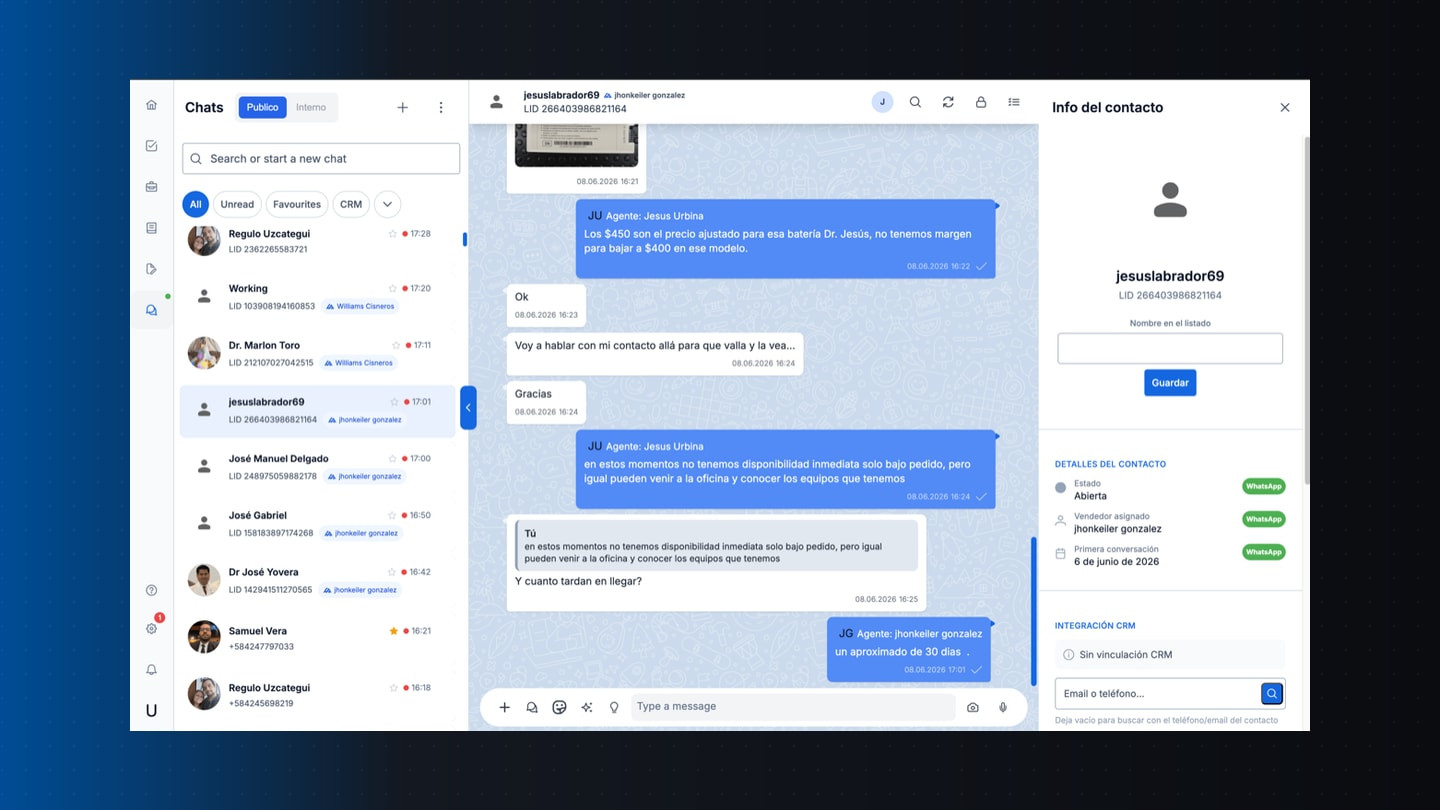
The inbox is already the UI
Support teams do not wake up wishing for another module. They live in WhatsApp, email, and Instagram DMs: threads that never share context. Generic chatbots optimize for deflection. Operators optimize for resolution without losing the thread.
Ayentic starts from a product rule we keep repeating in design reviews: the chat is not a feature bolted onto a CRM. It is the primary interface. Kanban boards, pipelines, and reports are views on what already happened in conversation. If the chat fails, nothing downstream matters.
The work case study covers stack and architecture. This post is the product story: what we optimize for, what we refuse to automate, and why "symbiotic AI" is more than a tagline.
Symbiotic, not autonomous
We use symbiotic deliberately: the model proposes, the human disposes.
Default mode for operators is suggestions: typically three response options ranked by relevance, built from the organization's tone and history, not a generic corpus. The agent picks one, edits it, or writes from scratch. Every selection is signal. If an operator always rewrites option B the same way, the next cycle should reflect that without a separate "rate this suggestion" ritual.
We also ship autonomous and supervised modes where policy allows, but the default protects trust on high-stakes channels (municipal clerks, medical-adjacent SMEs, anyone who has been burned by a confident wrong answer).
That posture sits in the same venture family as Sureva's on-prem consulting (sovereignty and auditability), but Ayentic is product engineering, not a slide deck.
One conversation, many objects
Each thread is an entity with:
- Message history (the visible timeline)
- Linked context: tasks, quotes, tickets, orders attached to the same contact
- Conversation state: open, waiting, escalated, resolved (flagging, not silent drops)
- Per-conversation AI context wired to a global orchestrator, not a stateless prompt per message
The operator should not copy-paste IDs between systems. The system should carry context across channels when the same person writes on WhatsApp after emailing yesterday.
Why we split the runtime
Ayentic is not a single Angular app with a cron job. We run a split runtime:
- Webapp: operator UX (Angular 21, signals, PrimeNG)
- Realtime gateway: WhatsApp sessions (Baileys), Socket.IO, channel adapters
- Worker: heavy or slow jobs so a stuck import does not freeze the inbox
That split is boring infrastructure until a Baileys session drops mid-shift and three operators lose visibility. Then it is the difference between "restart the browser" and "page someone at 22:00."
We document agentic routing (planning + ReAct + reflection) in a separate post: Agentic design patterns: a decision tree that saved us from over-engineering. Ayentic's orchestrator follows that tree; this post stays on operator experience.
What chapter one does not claim
- We are not claiming full autonomous resolution for regulated threads.
- We are not replacing HubSpot or your CRM; we integrate where clients already commit.
- Landing and domain migration (ayenticapp.com) are in motion; the engineering case study links the current public landing.
What we are building next
Chapter 2 is live: three modes in the inbox (and why the AI gets an overlay) covers suggestion / automatic / manual AI modes, client vs internal vs copilot send contexts, and escalation the operator can see.
Still ahead:
- Morning brief and cross-conversation patterns (orchestrator outputs operators actually read)
- Linked objects (tasks, quotes, tickets) from chat without duplicate data entry
If you are building multichannel support and want the architecture conversation, start with the Ayentic work page. If you want the consulting layer (on-prem, Netzica infrastructure), see Sureva.
Related: Chapter 2: inbox modes and overlay · Building Ayentic (work) · Sureva: building AI that survives contact with reality · Agentic design patterns